
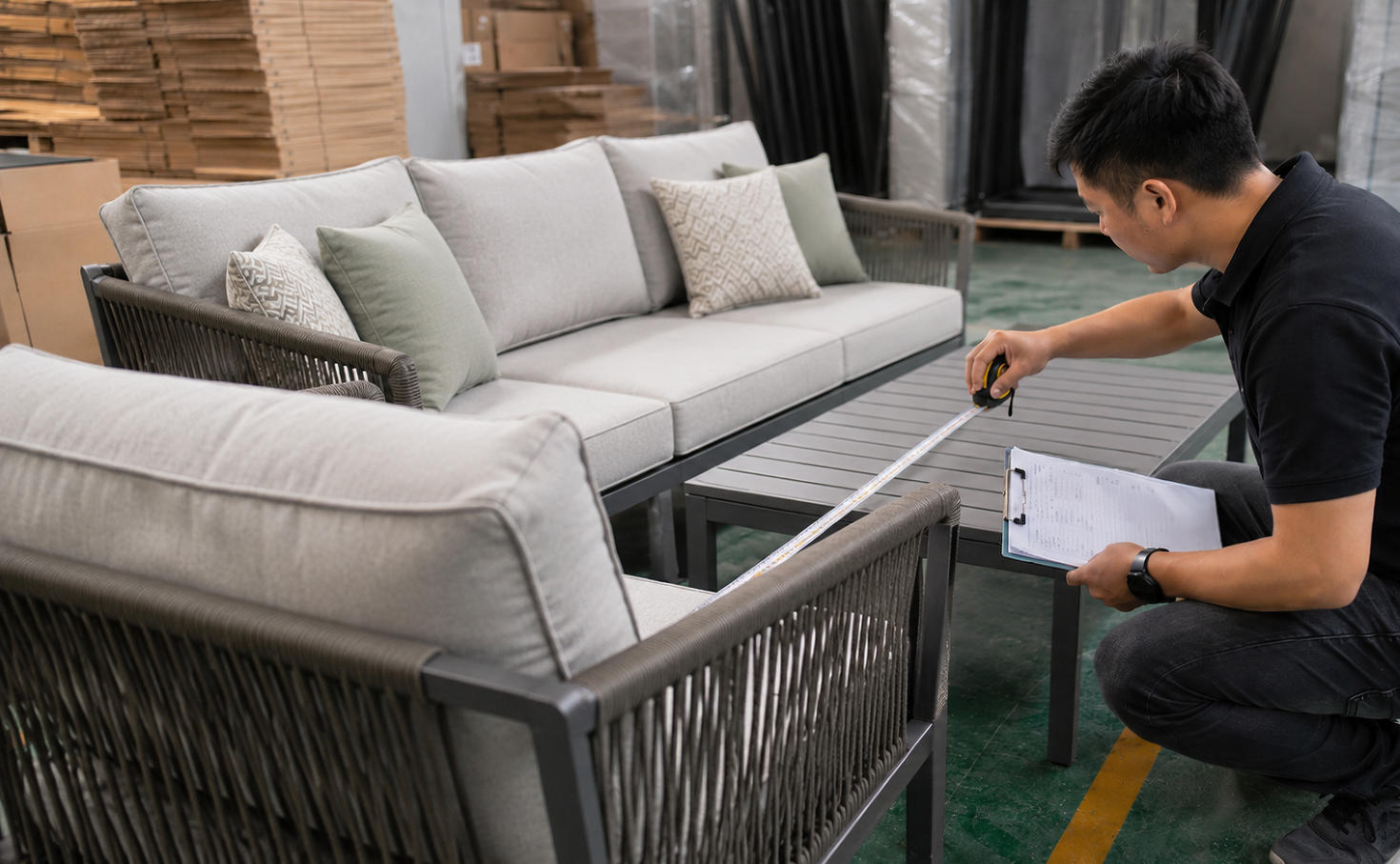
Outdoor furniture inspection China is an important step for overseas buyers before shipment. For buyers sourcing garden furniture, patio furniture and outdoor FF&E from China, pre-shipment inspection helps verify product quantity, dimensions, aluminum frame quality, coating finish, cushion workmanship, packaging and shipment readiness before the goods leave the factory.
This article explains an outdoor furniture quality inspection checklist based on a recent pre-shipment QC case for an overseas buyer. In this case, the buyer had already selected the supplier and placed the order directly. E-REACHING was involved as an independent third-party inspection team before shipment. The result showed why price, supplier selection, product specifications and quality control should be managed together, not separately.
Inspection Background: A Real Outdoor Furniture Pre-Shipment QC Case
The inspection was arranged as a final inspection before shipment for an outdoor furniture order. The product range included aluminum outdoor sofas, a coffee table, dining chairs, a dining table, sunbeds, side tables and an umbrella. The main materials included aluminum frame, outdoor cushions, rope elements and outdoor-use components.
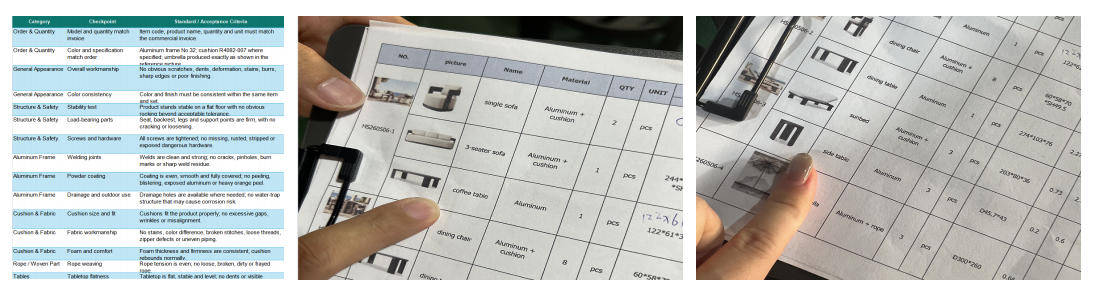
Before checking the physical products, the inspector reviewed the product list and order information. This step is important because the inspection must first confirm whether the goods on site match the buyer’s order, including item codes, product names, quantities, dimensions, materials and key remarks.
Why Outdoor Furniture Inspection Is Different from Indoor Furniture Inspection
Outdoor furniture faces different use conditions compared with indoor furniture. It may be exposed to sunlight, humidity, rain, temperature changes and frequent movement. Therefore, inspection should focus not only on appearance, but also on frame structure, coating quality, welding, cushion performance, fabric workmanship, drainage design, hardware condition and packaging protection.
For overseas buyers, outdoor furniture quality problems can become expensive after export. A dented aluminum frame, poor welding, uneven tabletop, incorrect dimension, weak cushion workmanship or insufficient packaging may affect customer satisfaction, replacement cost and after-sales responsibility.
Outdoor Furniture Final Inspection Checklist
A professional outdoor furniture inspection should be adjusted according to the product type. However, the following checklist covers the most common checkpoints for aluminum outdoor furniture, garden furniture sets, patio sofas, dining sets, sunbeds and umbrellas.
1. Product List, Model and Quantity Verification
The first step is to confirm whether the inspected products match the buyer order. This is especially important for mixed outdoor furniture orders because one shipment may include multiple product types, sizes and accessories.
- Check item codes against the order or invoice.
- Check product names, pictures and models.
- Check order quantity and inspected quantity.
- Check whether each item matches the approved material and color specification.
- Check whether spare parts, cushions, bases, umbrellas and accessories are included.
- Check whether packing information and carton marks are prepared correctly.
2. Dimension and Specification Check
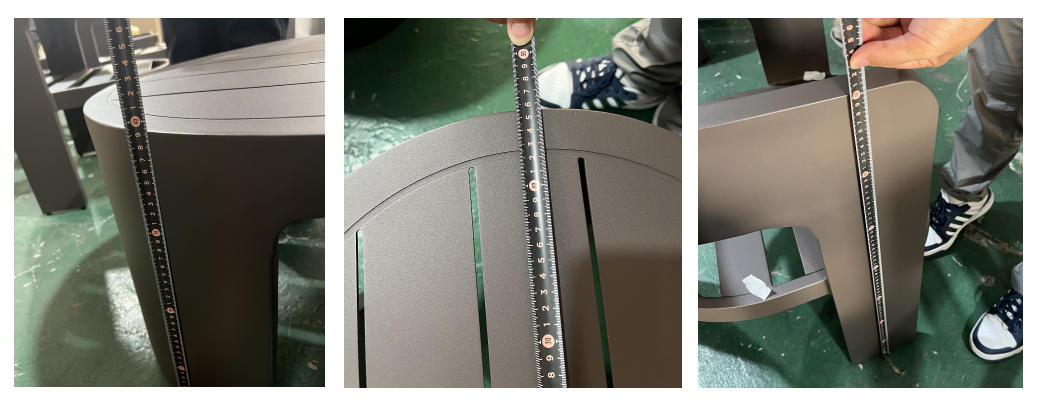
Outdoor furniture dimensions should be measured against the approved order details or drawings. Size differences can affect comfort, installation, container loading and final use. For example, seat height, table height, backrest height, chair width and product depth should be checked carefully.
- Measure overall length, width, height and seat height where applicable.
- Check table height, tabletop size and leg position.
- Check sofa and chair seat height, backrest height and sitting depth.
- Check sunbed size, height and reclining function if applicable.
- Record any measurement difference that requires buyer confirmation.
3. Aluminum Frame and Welding Inspection
Many outdoor furniture products use aluminum frames because aluminum is lightweight and suitable for outdoor use. However, aluminum frame quality still needs careful inspection. Incomplete welding, dents, sharp edges, poor sanding or weak connection points may affect both appearance and durability.
- Check welding joints for gaps, cracks, pinholes, burn marks and incomplete welds.
- Check frame corners, armrests, legs and connection points.
- Check whether welded areas have been sanded smooth.
- Check for visible dents, deformation or uneven frame lines.
- Check whether sharp edges or rough finishing may create safety risks.
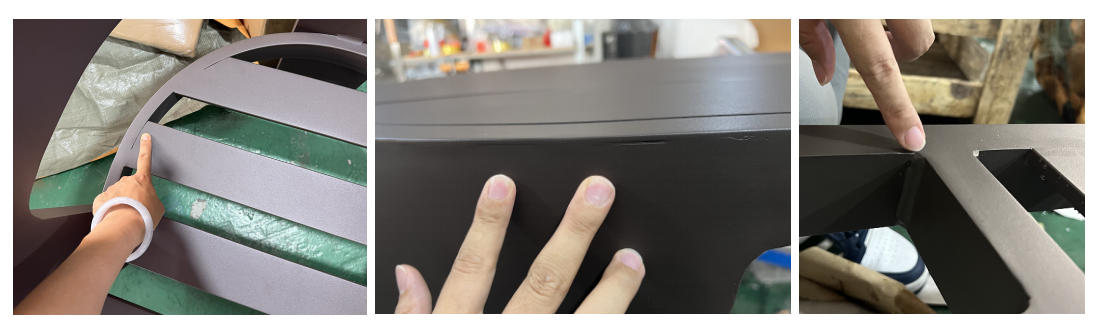
In this inspection case, several aluminum frame issues were found, including incomplete welding, dents and unsmoothed connection areas. These problems required rework before shipment approval.
4. Powder Coating and Surface Finish Check
Outdoor furniture coating quality affects both appearance and outdoor performance. The inspector should check whether the coating is even, clean and consistent. Surface particles, paint chipping, scratches, rough areas and color differences should be recorded with photos.
- Check coating consistency on visible and inner sides.
- Check for scratches, dents, paint chips and surface particles.
- Check whether corners, joints and inner edges are properly finished.
- Check whether the color matches the approved sample or specification.
- Check whether defects are minor, major or require rework before shipment.
5. Tabletop Flatness and Panel Alignment
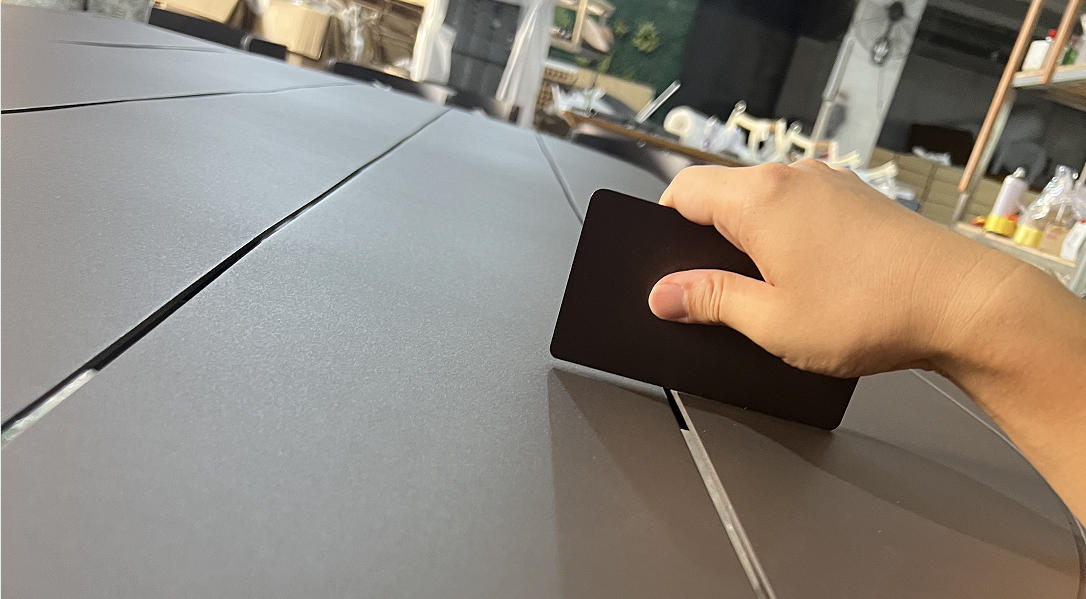
For outdoor coffee tables and dining tables, tabletop flatness is a key quality point. A visibly uneven tabletop can affect appearance, use experience and customer acceptance. Aluminum tabletop panels should be checked for height differences, deformation, gaps and surface dents.
In this inspection case, the coffee table and dining table showed uneven tabletop panels, with height differences exceeding 2 mm in some areas. This was recorded as a quality issue because it affected the visible appearance and required supplier correction or buyer confirmation.
6. Cushion, Fabric and Sewing Inspection
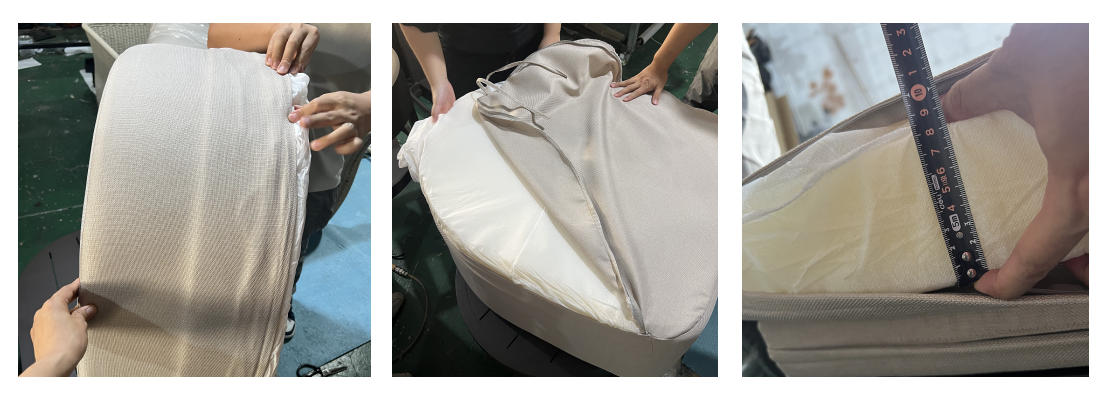
Outdoor cushions need to be checked for appearance, foam position, fabric condition, stitching quality, zipper function and fit on the furniture frame. A cushion may look acceptable from a distance but still have foam misalignment, visible wrinkles, uneven corners or poor sewing details.
- Check cushion size and fit with the furniture frame.
- Check fabric surface for stains, holes, marks, wrinkles and color difference.
- Check whether foam is evenly positioned inside the cushion cover.
- Check stitching, seams, piping, corners and edge tension.
- Check zipper operation and whether it opens and closes smoothly.
In this case, cushion-related issues included foam misalignment, visible indentation in the cushion surface, edge wrinkling and zipper operation problems. These details can affect both appearance and customer satisfaction after delivery.
7. Function, Stability and Safety Check
Outdoor furniture should stand stable on a flat surface and should not have obvious rocking, loose parts or unsafe sharp edges. Seating products should be checked for basic stability, frame strength, armrest condition, leg contact and support points.
- Place the product on a flat floor and check stability.
- Check whether legs, frames, armrests and backrests are firm.
- Check visible load-bearing parts and support points.
- Check whether there are loose screws, missing hardware or unsafe exposed parts.
- Check adjustable or reclining functions where applicable.
8. Packaging and Shipment Readiness
Outdoor furniture is often bulky and easy to damage during handling and transportation. Packaging should protect the aluminum frame, tabletop, corners, cushions, legs, glass, stone or other fragile parts. Packaging inspection should also check whether carton marks and product identification are clear.
- Check whether visible surfaces and corners are protected.
- Check carton strength, wrapping, foam, corner protection and inner separation.
- Check whether hardware and accessories are packed clearly.
- Check carton marks, item codes, quantity and packing list consistency.
- Check whether the products are ready for loading or still require rework.

Common Defects Found in Outdoor Furniture Final Inspection
Based on this inspection case, the main defects were not only cosmetic issues. They included structural, dimensional, surface and cushion workmanship problems. These are the types of issues that overseas buyers may not discover until the goods are inspected on site.
| Defect Type | Example Found During Inspection | Why It Matters |
|---|---|---|
| Incomplete welding | Visible gaps and incomplete welded areas on aluminum frame parts. | May affect appearance, perceived quality and structural confidence. |
| Frame dents | Dents found on aluminum frame and connection areas. | Affects visible appearance and may require rework before shipment. |
| Uneven tabletop | Height differences over 2 mm between aluminum tabletop sections. | Creates visible unevenness and may affect use experience. |
| Incorrect dimensions | Actual chair dimensions and seat height did not fully match the order specification. | Can affect comfort, project fit and customer acceptance. |
| Coating defects | Paint chipping, surface particles and rough areas. | Affects appearance and may reduce buyer confidence in finishing quality. |
| Cushion defects | Foam misalignment, center indentation, edge wrinkles and zipper difficulty. | Affects comfort, appearance and after-sales satisfaction. |
What This Case Shows About Direct Factory Sourcing
In this inspection case, the buyer had already selected the factory and placed the order directly. E-REACHING was involved as an independent third-party inspection team before shipment. This is a common situation for overseas buyers: buying directly from a source factory may look more cost-effective at the beginning, but the buyer also carries more responsibility for supplier verification, product specification control, production follow-up and final quality checking.
A lower factory price does not always mean a lower total risk. If the supplier is not familiar with the buyer’s quality expectations, export packaging requirements or project standards, problems may only become visible at the final inspection stage. In this outdoor furniture inspection, several issues were found before shipment, including aluminum frame defects, incomplete welding, surface dents, uneven tabletop panels, dimension differences and cushion workmanship problems.
This does not mean direct factory sourcing is always wrong. Many good factories can provide strong value. The key point is that overseas buyers need a structured process to evaluate whether the factory is suitable for the order. Price should be compared together with material accuracy, production consistency, communication ability, rework cooperation, packaging method and inspection results.
When buyers work with E-REACHING for sourcing, we do not only search for products with attractive prices. We also help buyers review supplier suitability, compare quotations, check materials, follow up production and arrange quality inspection based on our project experience and QC standards. We prefer to work with factories that can cooperate with clear specifications, inspection requirements, correction requests and export preparation.
For buyers who have already placed orders with their own suppliers, E-REACHING can still support as an independent third-party inspection team. For buyers who want a more controlled sourcing process from the beginning, working with E-REACHING before placing the order can help reduce risks earlier, not only at the final inspection stage.
Direct Factory Sourcing vs Sourcing with E-REACHING
| Comparison Point | Direct Factory Sourcing | Sourcing with E-REACHING |
|---|---|---|
| Price | May look more direct and lower at the beginning. | Price is reviewed together with quality, supplier reliability and project risk. |
| Supplier Selection | The buyer needs to judge supplier capability independently. | E-REACHING helps shortlist suppliers based on product type, project requirements and cooperation experience. |
| Specification Control | The buyer must define and confirm all details with the factory. | We help check product lists, materials, dimensions, colors, samples and key requirements before production. |
| Quality Risk | Problems may only become visible at final inspection or after arrival. | Quality risks can be reduced earlier through supplier review, sample checking, production follow-up and QC planning. |
| Communication | The buyer communicates directly with the supplier and handles all follow-up. | E-REACHING coordinates supplier communication, inspection points, correction requests and export preparation. |
| Rework Follow-Up | The buyer needs to push the supplier for correction. | We can help report issues clearly and follow up on correction or re-inspection requirements. |
| Suitable For | Experienced buyers with time, local support and strong supplier control ability. | Buyers who want a more controlled sourcing process, clearer QC standards and local coordination in China. |
Inspection Result: Why Rework Was Required Before Shipment
In this case, the final inspection result was not approved for immediate shipment because several major issues required supplier rework or buyer confirmation. The main reasons included aluminum frame defects, incomplete welding, tabletop unevenness, coating and surface problems, dimensional differences and cushion workmanship defects.
This is exactly why pre-shipment inspection is important. If these issues were not found before shipment, the buyer might only discover them after the goods arrived overseas, when correction would be much more difficult and expensive.
What Buyers Should Prepare Before Outdoor Furniture QC
To make inspection more effective, buyers should provide clear documents and requirements before the inspector visits the factory or warehouse.
- Purchase order or invoice.
- Product list with item codes, names and quantities.
- Approved drawings, dimensions and product photos.
- Material and color specifications.
- Approved fabric, cushion, frame or coating samples if available.
- Packaging and carton mark requirements.
- Known concerns that should receive extra attention.
- Shipment schedule and loading plan.
How E-REACHING Supports Outdoor Furniture Inspection in China
E-REACHING supports overseas buyers with outdoor furniture inspection, supplier coordination, production follow-up, packaging review, loading supervision and export coordination from China. Our role can be flexible depending on the buyer situation.
If the buyer has already placed the order directly with a factory, E-REACHING can act as an independent third-party inspection team before shipment. If the buyer wants sourcing support from the beginning, we can help with supplier search, factory comparison, quotation review, specification confirmation, quality control planning and final shipment coordination.
Our goal is not only to find furniture, but to help buyers reduce sourcing risk through a more controlled process, from supplier selection to final inspection and export readiness.
Outdoor Furniture Inspection FAQ
What should be checked during outdoor furniture inspection?
Outdoor furniture inspection should check quantity, item codes, dimensions, aluminum frame condition, welding, coating, surface finish, cushion workmanship, fabric, function, stability, packaging, carton marks and shipment readiness.
Why is aluminum frame inspection important for outdoor furniture?
Aluminum frames are commonly used for outdoor furniture, but they still need to be checked for incomplete welding, dents, deformation, rough edges, coating defects and weak connection areas. These problems may affect appearance, durability and customer acceptance.
Is buying directly from a source factory always better?
Buying directly from a source factory may look more cost-effective, but it also requires the buyer to manage supplier verification, specification control, production follow-up, quality inspection and shipment coordination. A lower price does not always mean lower total risk.
Can E-REACHING inspect goods from a factory selected by the buyer?
Yes. If the buyer has already selected a factory and placed an order directly, E-REACHING can support as an independent third-party inspection team before shipment.
What is the difference between third-party inspection and sourcing support?
Third-party inspection is usually arranged after the buyer has already placed an order and needs a final quality check before shipment. Sourcing support starts earlier and may include supplier selection, quotation comparison, specification confirmation, production follow-up, quality control and export coordination.
Related Support from E-REACHING
Continue with these related pages if you need sourcing, inspection or export coordination support from China: